

The Department of Mathematics and Statistics offers several different programs of study, at both undergraduate and graduate levels, covering traditional and modern areas of mathematics, statistics, and mathematics education.
Undergraduate Programs
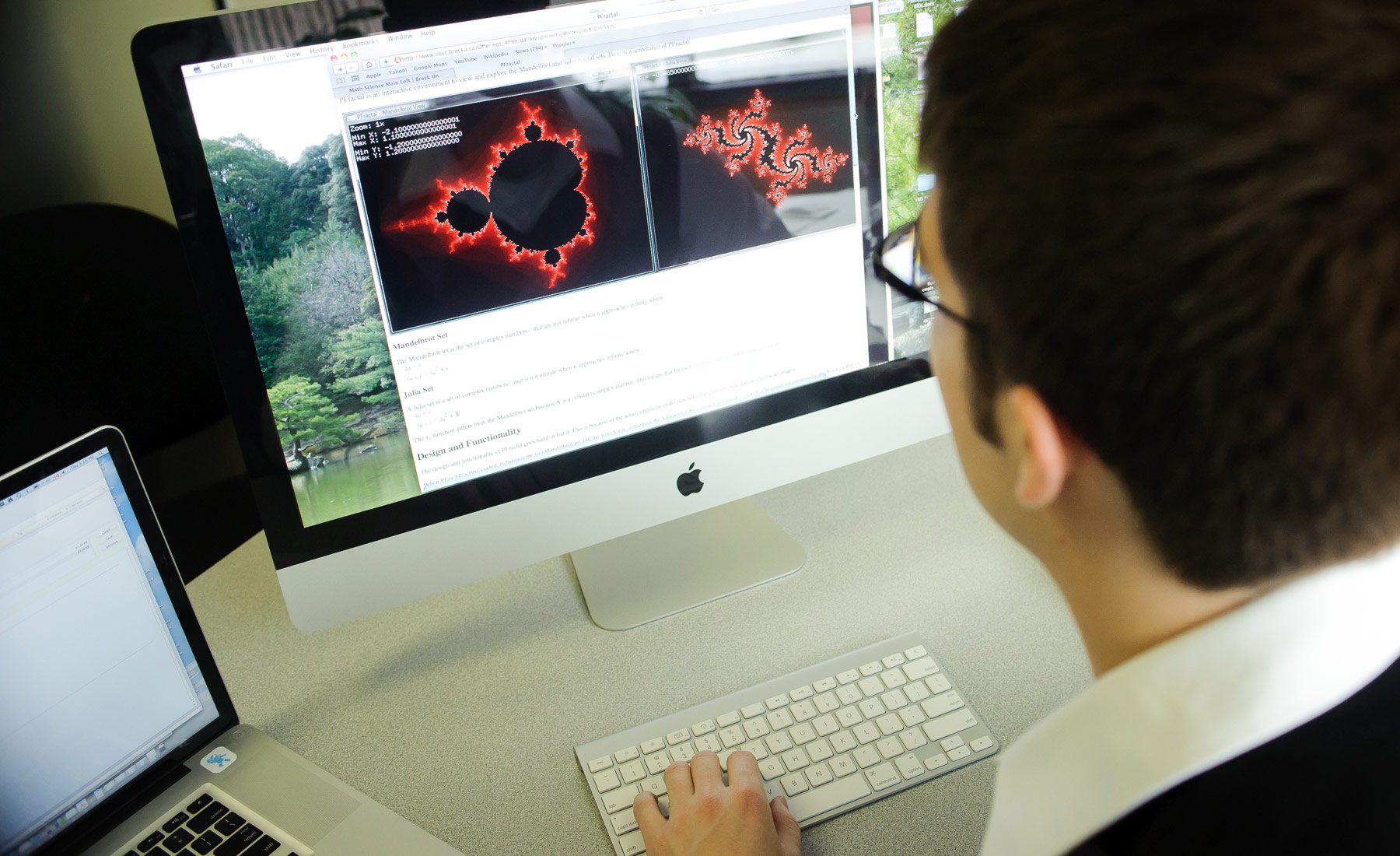
The primary undergraduate program offered by the Department is the BSc Honours in Mathematics and Statistics. This is a flexible program designed to meet a wide range of interests. There are core courses in calculus, linear algebra, differential equations, probability and statistics, as well as the use of computers to explore and solve mathematical problems. Within this program, students have the option to select a specialized concentration in one of five areas: Applied Mathematics; Pure Mathematics; Mathematics Integrated with Computers and Applications (MICA); Mathematics Education; and Statistics. Students also have the opportunity to complete an honours project or thesis under the supervision of a faculty member.
Normally the BSc Honours program requires four years to complete. A unique Accelerated Mathematics Studies stream is available for high-achieving students who want to complete the BSc Honours program in three years by following a personalized and accelerated study-plan. Students in this stream are able to take accelerated reading courses and optional summer courses in mathematics and statistics.
For students interested in combining academic studies with real-world work experience, the Department offers Co-op programs in Mathematics or Statistics. Completion requires four and one-half years.
Minor programs in either Mathematics or Statistics, as well as a three-year pass program in Mathematics and Statistics are also offered.
The Department has a special interest in Mathematics Education and offers several programs and courses specifically for prospective teachers. These include both Concurrent Education and Consecutive Education programs, as well as Minors for future teachers. Students in the Concurrent Education program, which falls under the Faculty of Education, need to complete a BSc degree and a popular choice is the BSc in Mathematics and Statistics.
In addition, the Department offers combined major programs with Biological Sciences, Chemistry, Computer Science, Economics, and Physics.
An important initiative which is in the final stages of approval is a new Data Science program being developed in collaboration with Computer Science and the Faculty of Business. The Department has taken on a lead role in the creation of this program.
For program or general inquiries, please contact [email protected]
Graduate Programs
The Department offers a MSc program whose aim is to give students a rich experience of classical and modern mathematics and statistics for fostering the acquisition of advanced skills and knowledge, as well as supplying a strong foundation on which to pursue further graduate or professional studies or to enter the job market. Students choose a specialization in either Mathematics or Statistics.
The Mathematics specialization provides students with advanced training in areas of active research and current applicability in algebra and number theory, computer algebra algorithms, control theory, discrete mathematics and graph theory, dynamical systems, evolutionary game theory, partial differential equations, functional analysis, mathematical music theory, mathematics education, mathematical physics, solitons and integrable systems, topology, and – as a bridge with the Statistics specialization – computational data science.
The Statistics specialization provides students with solid training in both advanced and applied statistical areas including design of experiment, optimal design for regression, sampling theory, parametric and nonparametric statistical inferences, survival analysis and risk models, robust methods, and computational statistics. Areas intersecting with data science such as machine learning and predictive biology/ecology are represented as well.
For program or general inquiries, please contact [email protected]