Faculty Research Interests
Department of Chemistry
Faculty Research Interests

Our research is focused on the bioorganic chemistry of vitamin E (tocopherol). We synthesize affinity label and fluorescent analogues of tocopherols as well as specifically deuterated versions to inspect the in vitro and in vivo transport and metabolism of this antioxidant vitamin. We also express several human and animal tocopherol transfer/binding proteins (including naturally occurring and designed mutants) which are then used to explore their role in transferring tocopherol and other molecules between lipid environments. State of the art fluorescence spectroscopy, including stopped flow methodologies, are used to explore the rates and mechanisms of transfer.

Ian Brindle's research interests focus on trace element analysis, sample introduction methods, development of methods particularly for the determination of hydride forming trace elements and their species, environmental analytical organic chemistry and trace element analysis in relation to archaeological provenance, phyto remediation of heavy metals.

Travis Dudding's research group focus on the use of computational and experimental chemistries for stereoselective catalyst design and the development of asymmetric procedures. Specific projects address:
- The rationalization of stereoselection afforded by and the design of N-heterocyclic carbenes (NHCs) as catalysts for the benzoin and Stetter reactions
- The development of novel annulation reactions catalyzed by NHC organocatalysts
- The rationalization of the levels of asymmetric induction in Bronsted acid catalyzed [4+2]-Diels Alder cyclizations.

Heather Gordon's research interests focus on statistical mechanical investigations of biologically relevant molecules via Monte Carlo and molecular dynamics simulations. Current projects include Monte Carlo simulations designed to study how the inherent flexibility of the six peptide loops of the antibody complementarity determining region contributes towards antibody-antigen recognition and binding. Other research interests include molecular modelling for structural analysis and applications of pattern recognition to problems of chemical interest (e.g. quantitative-structure activity relationships; comparative molecular field analysis (CoMFA)).

Organic synthesis, biocatalysis, electrochemistry, asymmeric catalysis
Our group is engaged in a variety of projects ranging from total synthesis to investigations of new reactions and the design of enzyme inhibitors. In total synthesis, we work on implementing reliable and efficient routes to target molecules. Our ventures are exact and logical pursuits, yet serendipity, intuition, and art all form an integral part of designing a total synthesis.
We have exploited the biooxidation of aromatic compounds in an exhaustive approach to the synthetic design of carbohydrates and their derivatives. Our guiding principles are symmetry, simplicity, and precise order of operations so that any derivative or stereoisomer with a sugar backbone can be constructed. These products are tested for glycosidase inhibition, a process important in viral expression. In addition, carbocyclic sugars can act as cell messengers, and their availability through synthesis allows greater understanding of cellular communication. Oligomers of inositols can also be exploited in a rational design of templates for asymmetric synthesis and in the design of chiral polymers.
Morphine, pancratistatin, and taxol are other important molecules in which our group has invested much synthetic effort. Their total synthesis permits the investigation of new reactions and mechanistic pathways, which can then be applied in subsequent syntheses. Current effort is focused on designing a practical synthesis of morphine and analogs and in probing the active pharmacophore of pancratistatin in hopes of designing a more bio-available anti-tumor agent.
To address environmentally benign manufacturing, or Green Chemistry, we are exploiting organic electrochemistry as replacement technology for metal-based oxidizing and reducing agents.
Finally we are devoting some effort to studies in the mechanism of prokaryotic oxygenase enzymes. Our ultimate goal is the design of a synthetic enzyme mimic that can be used as a chiral reagent for aromatic cis-hydroxylation.

Our research program is focused on designing new chiral reagents and catalysts for applications in asymmetric synthesis. The targets have structural features that are expected to provide complementary reactivity and/or improvements in stereoselectivity over known reagents, but have been difficult or impractical to make in the past. Our intention is to develop viable routes to these materials to allow their systematic evaluation as catalysts.
To this end, we have developed a route to benzannulated N-heterocyclic carbenes (NHCs) derived from phenanthrolines and in which the positions of the stereogenic centers are in closer proximity to the carbenoid centre than in "Grubbs-like" NHCs. More recently, we have devised asymmetric syntheses of C1-symmetric pyrroloimidazol(in)ylidene NHCs, which also have proximal chiral centers in a ring. This development is significant for several reasons: (1) There is a lack of previous examples of these reagents because they require lengthy syntheses (2) As nucleophilic reagents they are expected to catalyze the formation of different products over more common thiazolium and triazolium precatalysts due to electronic differences. (3) The use of C1-symmetric "Grubbs-like" NHCs in enantioselective transition-metal-catalysis is increasing. (4) Bulky versions of pyrroloimidazol(in)ylidene NHCs may form "Frustrated" Lewis Pairs (FLPs) with B(C6F5)3 and activate small molecules such as H2 leading to potential development of metal-free hydrogenation and other reactions.
We are also currently developing an enantioselective synthesis of planar chiral aminoferrocenes of in which nitrogen is directly attached to the cyclopentadienyl (Cp) ring. This class of compounds is not easily accessible so there has been little in-depth exploration of enantiopure aminoferrocene ligands. Our unique approach to their preparation starts with aminoferrocenes, whose complexes with BF3 undergo enantioselective lithiation–electrophile quench on the Cp ring to give products of considerable structural diversity. This method, under patent protection in the U.S. and Canada, has yielded aminoferrocenes with unusual substitution patterns, such as 1,2-aminophosphines. Preliminary applications of these ligands in asymmetric iridium-catalyzed hydrogenation have given excellent levels of enantioselectivity, which bodes well for their further development.

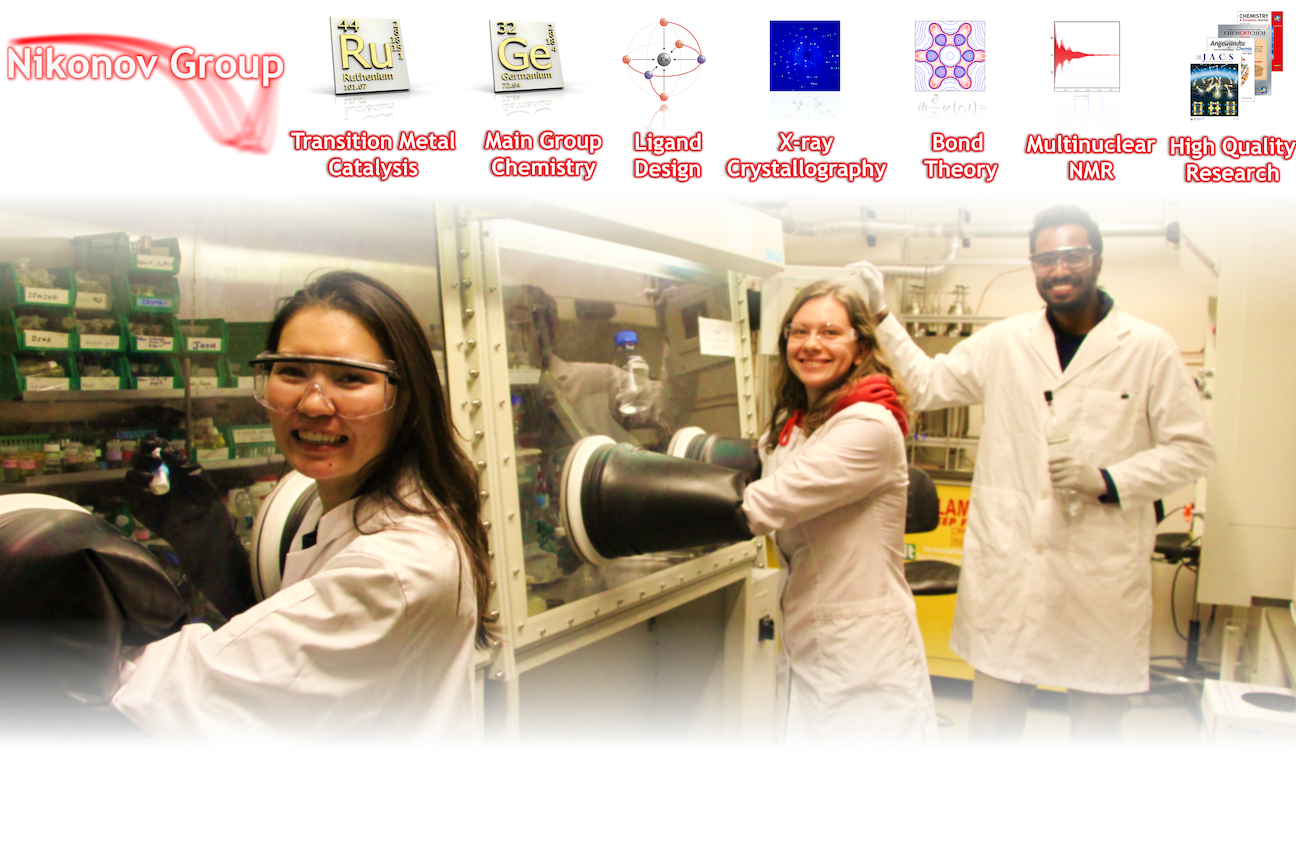
We are interested in developing the organometallic and coordination chemistry of transition metal complexes featuring main-group element ligands (E=B, Al, Si, Ge, Sn, Pb, P, As, Sb, Bi). Such complexes are encountered in many important main-group element transfer processes, such as hydroboration, hydrosilation, Suzuki coupling, dehydrogenative silane coupling etc, and in addition often exhibit unusual M-E and/or interligand (for instance, E…H) bonding. In this venue, our research is focused on two main topics:
1) The development of new effective synthetic approaches to the main-group element substituted complexes and investigation of their synthetic and catalytic activity. We have been successfully applying the synthetic potential of transition metal hydride in the construction of M-E bonds. Therefore, we also have strong interest in the general problems of hydride chemistry;
2) Much of our recent work has been recently directed toward the investigation of non-classical interligand Si-H, B-H and Si-Si interactions. In particular, we pioneered the study of Interligand Hypervalent Interactions (IHI) and stretched agostic Si-H interactions.
Our research touches many synthetic, structural and theoretical aspects of transition metal complexes, including inter alia the design of new ligand environments, X-ray and neutron diffraction analyses, and bond theory.

Research in the Pilkington group spans topics in synthetic and structural inorganic chemistry with a focus on the problems at the interface of supramolecular and materials chemistry. Our aim is to define and address important synthetic challenges and tackle their solution with a wide range of physical, chemical and spectroscopic data. The techniques of X-ray crystallography, magnetometry, mass spectroscopy and electrochemistry are particularly important in our studies and reflect the breadth of the problems under investigation.
One of the major challenges facing synthetic chemists working in the area of molecular materials is the design and preparation of dual property materials e.g. combining electronic with optical and/or magnetic properties. Our approach attempts to address this challenge and focuses on the combination of metal centres with two classes of organic molecules, namely tetrathiafulvalene derivatives and phthalocyanines.

Stuart Rothstein's research interests focus on:
- Solving the Schroedinger Equation by using computer simulation methods
- Developing and applying new tools to explore biomolecular structure
Projects in the former area include:
development and application of algorithms to provide essentially exact
values for physical observables, including electrical and magnetic
properties of molecules, and derivatives of these with respect to nuclear
geometry and applied magnetic field.
Projects in the latter area include:
Applications of principal component-based software to uncover concerted
motions in biomolecules (e.g.; enzymes, viruses and neuropeptides) that
affect their biological functioning.
Our projects make substantial use of RISC UNIX computers located on campus and at high performance computing sites elsewhere in Canada. Professor Rothstein has an appointment in the Department of Physics, and he can supervise students in that department.


Art van der Est's research focuses on using modern time-resolved electron spin resonance (ESR) spectroscopy to study the structure and function of photosynthetic reaction centres and porphyrin-based model systems. In collaboration with Heather Gordon, computer modeling is also used to study these systems. Current projects involve mutagenesis studies of Photosystem I from cyanobacteria and green algae with the goal of gaining a better understanding of the electron transfer pathway and protein-cofactor interactions of phylloquinone and the iron sulfur cluster Fx. The work on porphyrin-based model systems is directed primarily towards developing techniques for studying metaloproteins and excited state dynamics. At present this involves theoretical and experimental work on the spin polarization and the spin dynamics of coupled triplet-doublet pairs in copper and vanadyl porphyrins.

Our research is focused on the bioorganic chemistry of biologically important macromolecules. We are interested in the development of methodology for the synthesis of deoxyribonucleotides on relatively large scales. Our work also involves the development of new platforms for efficient delivery of siRNAs to target cells. Other interests include chemical and enzymatic synthesis of complex carbohydrates and glycoconjugates pertaining to human health.
POSTAL ADDRESS
Dept. of Chemistry
Brock University
500 Glenridge Ave.
St. Catharines, ON
Canada, L2S 3A1
Tel: (905) 688-5550 x3406
Administrative Assistant
cskorski@brocku.ca
Webmaster:
rsimionescu@brocku.ca


